 |
| found on Harry Potter Fandom |
When your security practices are informed by magical thinking, even children will find a way around your protective measures.

|
| found on Harry Potter Fandom |
When your security practices are informed by magical thinking, even children will find a way around your protective measures.

 |
| found on Bored Panda |
It's actually just street art, but the implication that you can bypass the locked gate by jumping over it seems to be intended. Also it does demonstrate a real phenomenon about bypass tools - some are better than others. Sometimes they're a lot better or a lot worse.
 |
| from here (image source) |
It's been said that locks merely keep honest people honest, but I disagree. Most people wouldn't have the first clue how to pick, bump, or otherwise bypass a lock. It's not stopping them because they're honest, it's stopping them because they don't know how to overcome it.
Everyone knows how to go around and obstacle, however. This is what keeping honest people honest really looks like.
 |
| from here and here (image source) |
I don't know, maybe if the gate was on the other side of the door the dog might not have been able to tear the door apart. Another possiblity might be one of those metal kick plates for the far side of the door, since the dog probably started tearing at the bottom and the metal should help prevent that. The key point, though, is to be aware of what kind of attack your defenses are likely to face, evaluate them on whether they are up to the task, and add additional layers to address weaknesses.
 |
| from here (image source) |
So long as you've got the approved access controls in place, you're all good. Who cares if the controls are effective, that's not what compliance measures. It doesn't matter that anyone who can navigate stairs can also navigate around this obstacle.
 |
| found on Acid Cow |
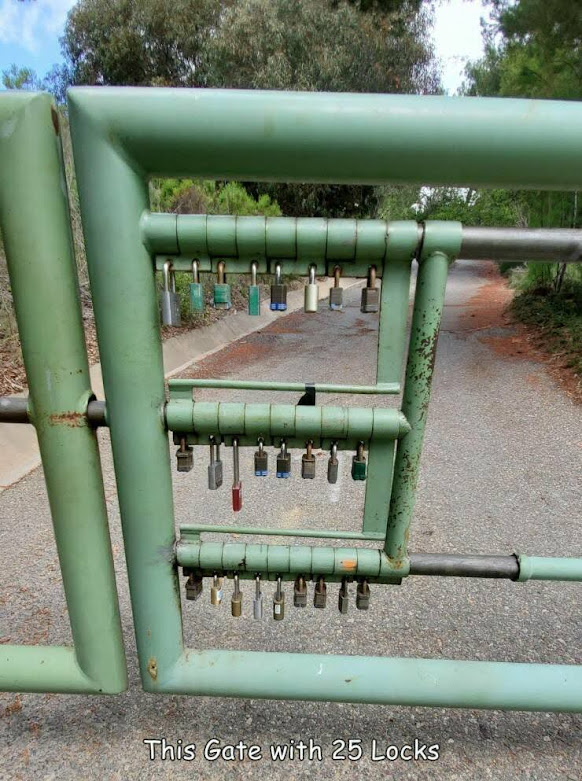
You've heard the saying that a chain is only as strong as it's weakest link? Well as this multi-user access gate demonstrates, something similar can be said of gates and locks. Of course most gates only have 1 lock so you might not even think of it in those cases, but even then it's still true (trivially so in fact).
 |
| from here and here (image source) |
You could go over. You could go around. There's a number of very easy ways to bypass this security.
 |
| from here and here (image source) |
Usually you don't have to choose between the two, unless someone does something really ill-advised like this.
 |
| found on Dump A Day |
 |
| from here (image source) |
What about the people who follow the paved path, you say? They would still need to turn in order to operate and enter the door. This would literally only stop the people who have to come at the door head on and can't avoid this very narrow barrier
 |
| from here (image source) |
I certainly hope they have another layer of security somewhere, because that gate isn't stopping anyone.
 |
| from here and here (image source) |
Now if your security measures are such that the wrong paths have less resistance than the right paths, then that's something you need to improve.
 |
| from here and here (image source) |
I feel confident that that gate will keep people out (or in) pretty effectively. How would you open it?
 |
| found on Evil Milk |
 |
| from here (image source) |
