 |
| from here (image source) |
It's compliant with the privacy policy, therefore privacy has been protected, right? RIGHT?!?!
If only things actually worked like that.

|
| from here (image source) |
It's compliant with the privacy policy, therefore privacy has been protected, right? RIGHT?!?!
If only things actually worked like that.

 |
| from here (image source) |
It's been said that locks merely keep honest people honest, but I disagree. Most people wouldn't have the first clue how to pick, bump, or otherwise bypass a lock. It's not stopping them because they're honest, it's stopping them because they don't know how to overcome it.
Everyone knows how to go around and obstacle, however. This is what keeping honest people honest really looks like.
 |
| from here (image source) |
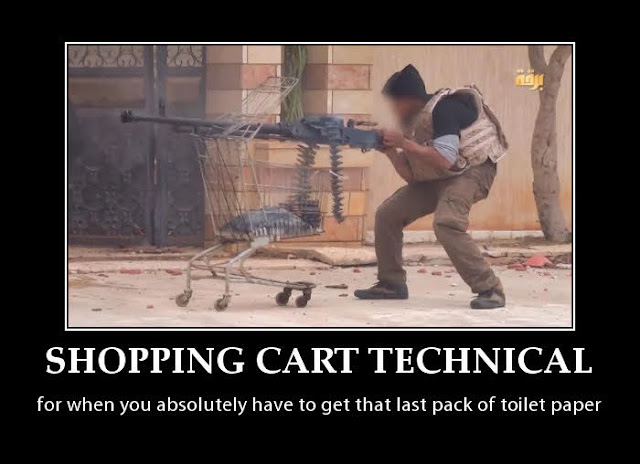
"The street finds its own uses for things" describes a situation where things are used in unanticipated ways, which is one of the core aspects of hacking. Hacking isn't confined to computers, of course, there are life hacks and car hacks and food hacks and hacks for everything in between (even shopping carts apparently). While I'm not endorsing violence, I can't ignore the creative problem solving on display here.
 |
| from here (image source) |
So long as you've got the approved access controls in place, you're all good. Who cares if the controls are effective, that's not what compliance measures. It doesn't matter that anyone who can navigate stairs can also navigate around this obstacle.
 |
| from here (image source) |
 |
| found on Memebase |
When you look like someone out of a horror movie (Poltergeist 2?) it's bound to creep out friends and enemies alike. I'm not sure that would actually serve as a meaningful deterrent, but one can hope.
 |
| from here (image source) |
Not only is it easy to tell what numbers are in the code, the order seems like it should be easy to guess as well. I feel confident that it's 1709 - it can be entered in a relatively fluid motion that saves time and effort. You might think that the door code should be changed on a more regular basis, but that would invite people to write it down and that that slip of paper could get lost or stolen and compromise the security. Instead the keypad should be better maintained and replaced when wear patterns start to give away the code.
 |
| from here (image source) |
I know it's not that we don't value privacy, but there are certainly times when we don't act like we value it. Public washrooms a good example of that. For all the problems they have it seems like no one is trying to design them better and some people are obviously designing them worse.
 |
| from here (image source) |
The only reason you'd want to lock up your ice cream is if someone you live with, someone who shares physical access to your freezer, was eating it and you didn't want them to. This isn't going to stop them. It's only going to upset them and that's not good when you're living with them. I would think twice before employing this technique if I were you.
 |
| from here (source article) |
I haven't made a secret about my feelings towards the Internet of Shit, but most of the time those connected objects at least provide the user with some compelling reason to use them. Often they give the user some novel feature or make something more convenient.
This scarf doesn't do any of that. It provides no extra functionality to the wearer beyond what a normal scarf would. You don't get to see the data, only some 3rd parties do. The best case scenario is that maybe someone will pay you to wear it, and you better hope they do because by extracting biometric data out of it they are definitely getting something of value in return.
 |
| from here and here |
I'm sure I'm not the only one who has seen the results of some comically misconfigured spambots before. I fully expect there are other misconfigurations that are just so broken that no one would ever see the results, except maybe the attackers themselves.
 |
| from here (image source) |
I've seen cars chained to posts as though they were bikes, and I've seen cars padlocked as though they were gates, but this might be the first time I've seen cars 'protected' as though they were phones.
 |
| from here (image source) |
If there WAS supposed to be a bike attached to that then you clearly locked the wrong part.
 |
| from here (image source) |
The anti-theft devices applied here are definitely not going to stop a thief of any calibre. It appears that there are instructions for cutting through wire (like the kind used by the anti-theft devices) right on the packaging of these pliers. You could probably swipe one of thees pliers with one hand tied behind your back.
 |
| from here (image source) |
It seems the incentives relating to getting security/privacy right in this bathroom are as misaligned as the sliding bolt hardware.
 |
| from here (image source) |
Fuzzing, or fuzz testing (who calls it that?) isn't about sticking a cat in the computer, however I suspect you may get some of the same random/invalid inputs if you try this.
 |
| from here (image source) |
You wouldn't think it was hard to cover up details but hiding details in documents, pictures, and video seems to be something that a lot of people actually do have difficulty with. Even without the reflection, the pixelation can actually be reversed. You might think it would be easier to just place a big black box over things, but even that can be problematic in things like PDF documents because you have the ability to highlight the covered text and read it.
 |
| from here (image source) |
If you want to blend in and go unnoticed, it's important to do some reconnaissance beforehand so that you know how to dress the part.
 |
| from here (image source) |
If the first lock doesn't stop the theft, the second and third aren't going to do it either. They're just the same preventative measure repeated multiple time. Best case scenario is if you put a ridiculous number of locks on it then maybe the thief will just consider it too annoying to steal.
If you're going to use multiple preventative measures it would be better to make them different so that if one fails maybe another won't.
